
Ground gas presents a significant risk to construction projects across the UK. Sources such as landfill sites, peat deposits, made ground, or naturally occurring geology can release harmful gases, including methane, carbon dioxide, and radon. Left unmanaged, these gases can accumulate beneath buildings, posing health risks to occupants, long-term durability concerns, and potential project delays.
At SPEEDECK, we understand that the success of a development lies not just in its structural integrity but in its resilience against environmental risks. Our piled raft foundation solution integrates seamlessly with ground gas protection measures, helping developers build safely and efficiently.

Evaluating Ground Gas Risk
The first step is always a robust site investigation. This involves:
- Desk Study: Reviewing historical land use, geology, and potential contamination.
- Gas Monitoring: Installing boreholes and monitoring gas flow, concentrations, and pressures over time to capture variations.
- Risk Assessment: Classifying the site under guidance such as CIRIA C665 and BS8485 to determine the required level of protection.
This stage is critical, as underestimating gas risk can result in costly remedial works later in the project life-cycle. Specialist advice should be sought in the interpretation and classification of gas measurements – your ground investigation provider should be able to assist.
Designing Mitigation Measures
Step two: Once risk levels are understood, suitable mitigation must be built into the foundation strategy. Gas protection measures are a vital part of ensuring long-term building safety, and when correctly specified and installed, gas membranes provide an effective mitigation.
However, on sites with a higher gas risk, a gas membrane alone does not provide sufficient mitigation. That’s why a holistic approach, combining membranes with engineered foundation-based protection, offers the most robust solution.
This is where a piled raft foundation solution stands apart:
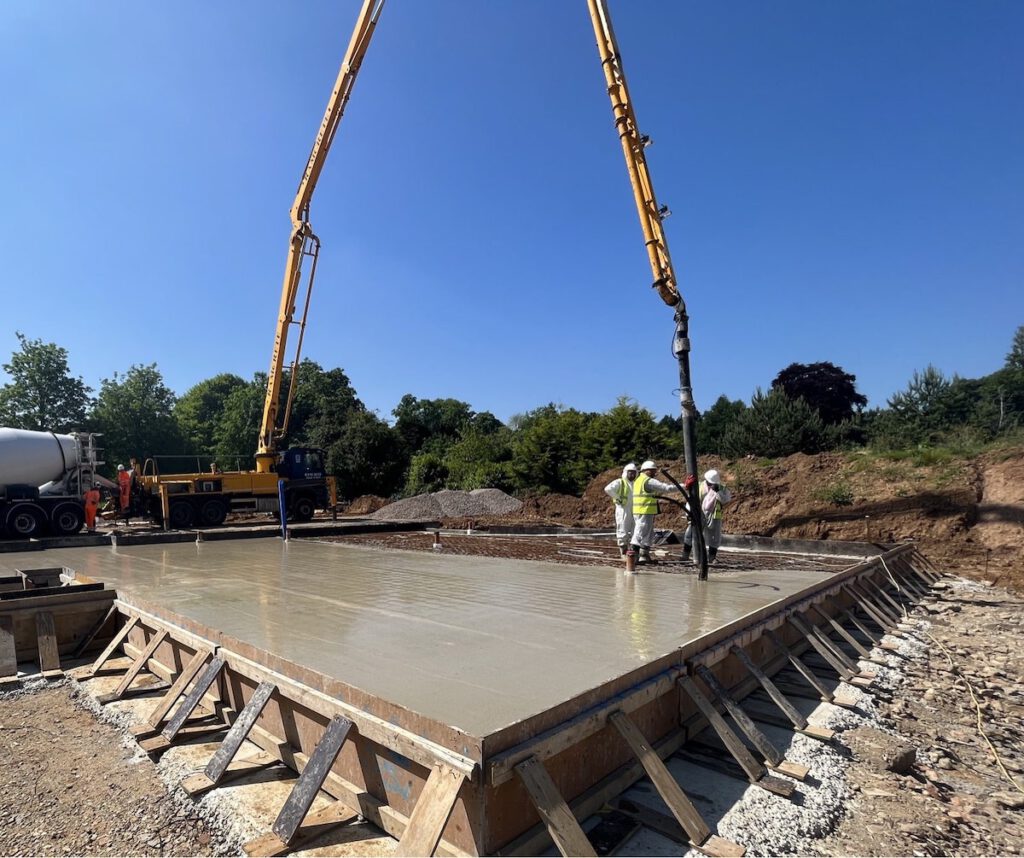
- Integrated Gas Protection: The raft slab itself offers gas protection. SPEEDECK’s raft slab meets the requirement for a cast in-situ monolithic reinforced floor slab with minimal penetrations, adding a further layer of protection.
- Optional Ventilation Pathways: For higher risk situations, if further mitigation’s are required, the piled raft foundation can be combined with sub-raft venting systems that safely disperse gases and allow for passive subfloor depressurisation.

Eastleigh Foundation Construction with Gas Venting Solution
Construction for ground gas protection
Step three: The construction stage should be carried out as carefully as the design:
- Specialist Installers: SPEEDECK’s rafts are constructed by skilled workers with significant experience to ensure the design intent is put into place on the ground. The installation of the gas membrane should also be carried out by specialists, to ensure it functions as intended.
- Quality Assurance: Controlled installation processes ensure long-term protection and performance.
Why Choose SPEEDECK for Gas-Risk Sites?
Ground gas risk doesn’t have to be a barrier to development. By integrating structural efficiency with environmental protection, our piled raft solution offers a cost-effective, robust, and future-proof foundation system.
- Streamlined installation reduces programme delays.
- Built-in mitigation enhance safety.
- A single solution addresses both structural and environmental challenges.
- Can be combined with additional mitigation to deal with more challenging sites.
With the right foundation system in place, developers can unlock sites that might otherwise be deemed too risky, turning complex ground conditions into viable, deliverable projects.
We installed a gas membrane over at Harbourside House in East Sussex, read more about this project here.