Selecting between a reinforced concrete raft slab and a traditional deep strip foundation is a pivotal structural design choice that determines a project’s early-stage budget and groundworks timeline. While deep strip foundations have long served as the baseline for low-rise developments, changing soil conditions and volatile muck-away costs mean they are often no longer the most economical solution.
For commercial estimators and project managers, choosing a substructure path requires a careful balance of localised soil bearing capacity, structural loads, and down-stream material efficiencies.
Technical Mechanics: How Load Transfer Mechanisms Differ
To properly evaluate structural viability, engineering teams must look beyond initial excavation costs and analyse how each system interacts with the underlying strata:
Traditional Strip Foundations: Point-Load Reliance
Deep strip or trench-fill configurations rely on transferring linear structural wall loads directly onto a concentrated strip of concrete poured deep into the ground. This system requires the soil at the base of the trench to have a high, uniform allowable bearing capacity. If the ground contains soft pockets or variable strata across the plot footprint, strip foundations are vulnerable to localised movement, leading to structural masonry cracking.
Engineered Raft Foundations: Diaphragm Stress Distribution
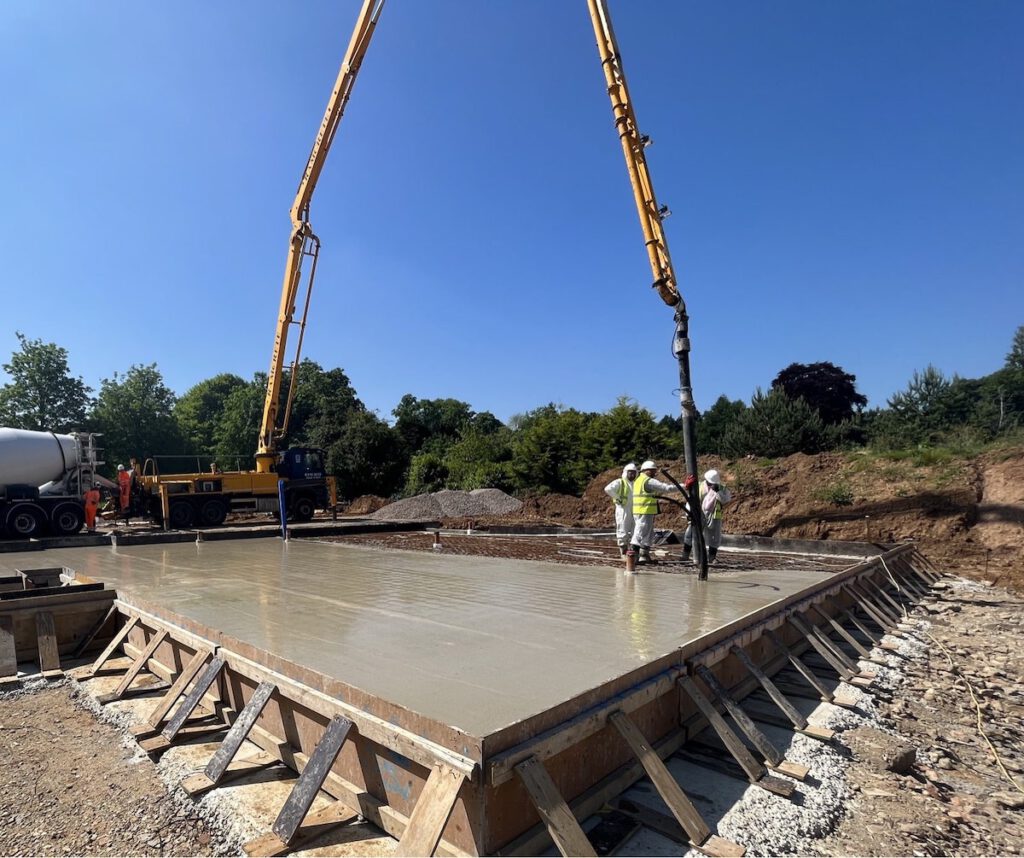
An engineered raft foundation behaves as a continuous, monolithic concrete slab that spans the entire footprint of the building. By acting as a rigid structural diaphragm, the raft distributes the overall building weight evenly across the entire surface area. This drastically lowers the ground bearing pressure required per square metre, making it an excellent choice for ground footprints that cannot support concentrated point loads.
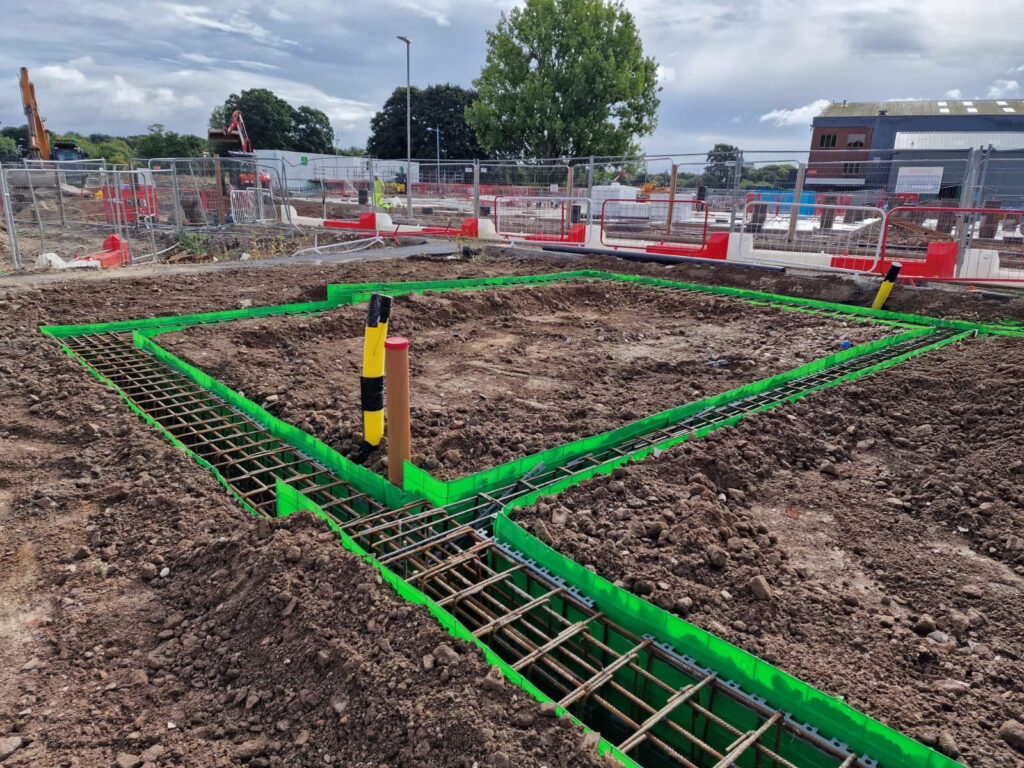
Strip Foundations from SPEEDECK Foundations
Geotechnical Selection Matrix: When to Pivot
Continuing to specify deep strip foundations on complex sites leads to unpredictable groundworks delays and unexpected budget increases. Engineering parameters dictate a shift to a raft design under the following clear site conditions:
- Variable Bearing Capacities: On brownfield sites, historic fill areas, or made ground where soil density changes rapidly every few metres, a raft slab can distribute loads across areas of variable bearing capacity, helping to reduce the risk of differential settlement where ground conditions vary across the building footprint.
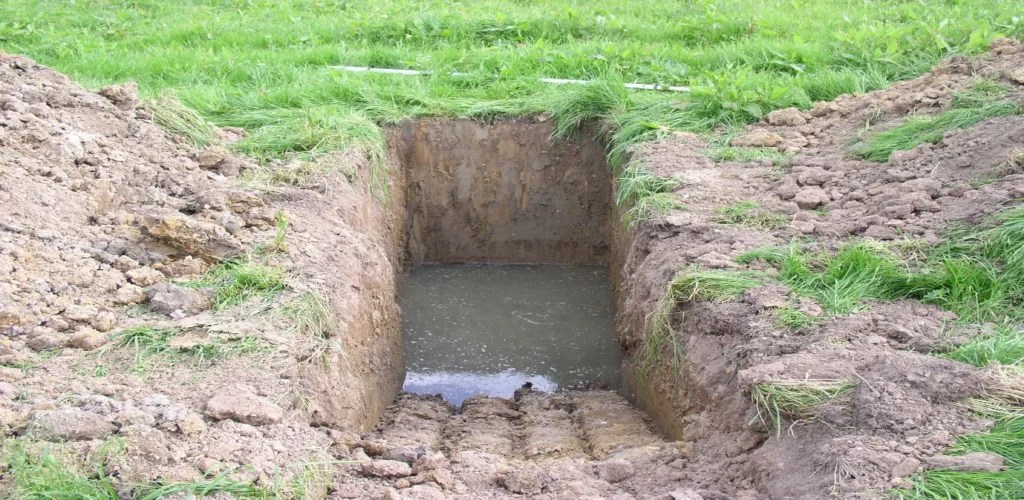
- High-Plasticity Clays (London Clay Strata): High shrink-swell soils require traditional strip foundations to be dug deep, often over 2.5 metres, to escape seasonal moisture changes. At these depths, trench wall instability spikes, and the volume of concrete required makes the project financially unviable.
- Shallow Groundwater Tables: Excavating deep trenches below an active water table triggers constant soil cave-ins and demands continuous, expensive site de-watering pumping systems. A raft foundation requires only a standard site strip, keeping all structural works safely above the water line.

Ground Bearing Raft Foundations with SPEEDECK Foundations
Structural Efficiency and Cost Comparison Matrix
When assessing the commercial viability of a multi-plot residential or commercial scheme, estimators must evaluate the total impact on follow-on structural trades:
- Excavation and muck-away volumes
-Engineered Raft Foundation – Minimal (Requires only a shallow topsoil strip)
-Traditional Deep Strip Foundation – High (Massive soil displacement from deep trenching) - Substructure brickwork and flooring
-Engineered Raft Foundation – None (Slab forms the immediate floor deck)
-Traditional Deep Strip Foundation -High (Requires extensive block underbuild & beam/block floors) - Material waste profiles
-Engineered Raft Foundation – Low (Singular, integrated concrete pour)
-Traditional Deep Strip Foundation – High (Prone to over-pouring in unstable trenches) - Groundwater de-watering risk
-Engineered Raft Foundation – Negligible (Works remain superficial)
-Traditional Deep Strip Foundation – Severe (High risk of trench flooding)

Piled raft foundations from SPEEDECK Foundations
The Monolithic Efficiency Advantage
Beyond pure concrete volumes, selecting an engineered raft simplifies the construction sequence for follow-on structural framing teams.
Because the finished raft slab serves as both the load-bearing foundation and the immediate, level ground floor deck, it entirely removes the need to schedule subsequent beam-and-block flooring installations or extensive substructure brickwork underbuilds.
By compressing these two distinct construction phases into a single, highly controlled concrete pour, developers regularly cut days off the substructure schedule. This allows framing crews to begin erecting timber, steel, or masonry structures on an organised, high-tolerance working platform immediately.